Mineral Rights vs. Royalty Interests: What’s the Difference?
If you own property in an oil and gas producing area—or inherited an interest from a family member—you may have heard the terms mineral rights, mineral interest, and royalty interest. These terms are related, but they describe different aspects of ownership.
Understanding what you own helps you evaluate an offer, review a lease, and decide whether to sell. The key is identifying the rights attached to your interest, rather than relying only on the royalty checks you receive.
The Short Answer
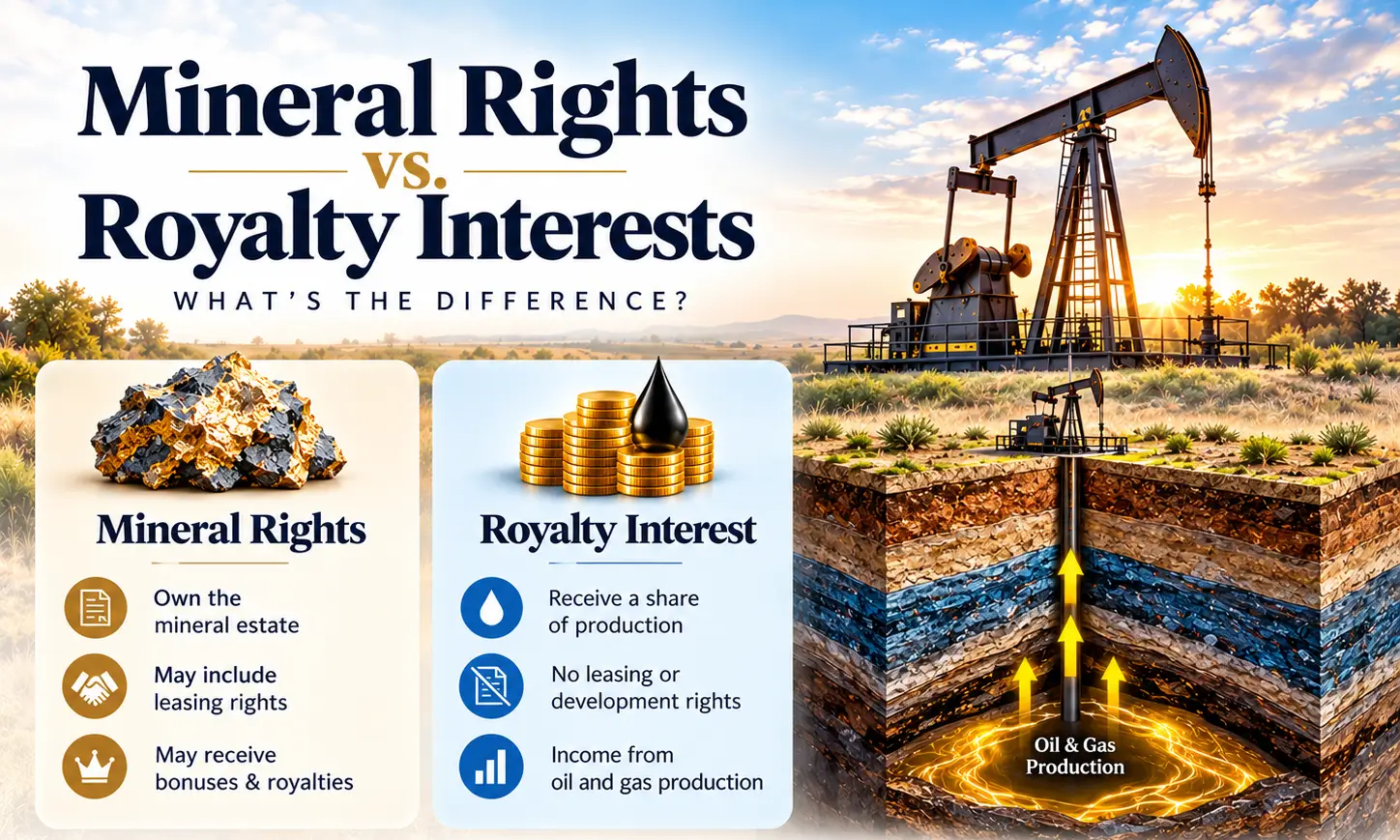
Mineral rights generally refer to ownership of all or part of the mineral estate. A mineral interest may include the rights to develop the minerals, lease them, receive lease bonuses and delay rentals, and receive royalties from production. These rights can be separated, so not every mineral owner holds all of them.
A royalty interest generally gives its owner a share of oil and gas production or the revenue from that production without the leasing and development rights associated with mineral ownership.
These categories can overlap. A mineral owner may receive royalties under an oil and gas lease while retaining underlying mineral ownership. Someone who owns only a royalty interest may receive production income without owning the broader bundle of mineral rights.
Owning a fractional mineral interest still means you own minerals. You do not have to own the entire mineral estate to be a mineral owner.
What Are Mineral Rights?
In Texas, the mineral estate can be separated from the surface estate. One person may own the surface while another owns some or all of the minerals beneath it.
Mineral ownership can also be divided among family members, buyers, or other parties. Prior deeds and reservations may separate particular rights or limit ownership to certain depths or minerals.
For example, a mineral owner may retain an interest in production while another party holds the right to negotiate and sign leases. The absence of leasing rights does not, by itself, establish that an interest is royalty-only. The documents creating and conveying the interest determine what the owner holds.
Common Types of Interests
Mineral Interest
A mineral interest represents ownership of all or part of the mineral estate. Depending on prior conveyances and reservations, it may include development rights, leasing rights, lease bonuses, delay rentals, and royalties.
Royalty Interest
A royalty interest provides a share of production or production revenue. Royalties received by a mineral owner under a lease are often called the landowner’s or lessor’s royalty. Royalty interests may also be reserved or conveyed separately from underlying mineral ownership.
Non-Participating Royalty Interest (NPRI)
An NPRI generally provides a share of production without the right to lease the minerals or receive lease bonuses or delay rentals.
An NPRI can exist before a lease is signed and may apply to production under future leases. It is not necessarily limited to the lease currently producing income. Its duration, coverage, and royalty calculation depend on the instrument creating it.
Overriding Royalty Interest (ORRI)
An ORRI is carved out of the working interest in an oil and gas lease. It provides a share of production without ownership of the underlying mineral estate.
Unlike an interest that continues across successive leases, an ORRI generally ends when the lease from which it was created terminates. Provisions addressing lease extensions or renewals and applicable law can affect that result, so the governing documents matter.
Unlike an interest that continues across successive leases, an ORRI generally ends when the lease from which it was created terminates. Provisions addressing lease extensions or renewals and applicable law can affect that result, so the governing documents matter.
A Quick Comparison
| Interest | What it generally includes | Leasing rights | Lease bonuses and delay rentals |
|---|---|---|---|
| Mineral interest | Ownership of minerals and the rights retained with that ownership | May include them | May include them |
| NPRI | A share of production or production revenue | Generally no | Generally no |
| ORRI | A share of production carved from a lease’s working interest | No executive right to lease the underlying minerals | Generally no |
| Mineral interest | Ownership of minerals and the rights retained with that ownership | May cover future leases, depending on its terms | Underlying mineral ownership generally continues after lease termination |
| ORRI | A share of production carved from a lease’s working interest | No executive right to lease the underlying minerals | Generally terminates with the lease, subject to its terms and applicable law |
The recorded documents determine the specific rights, limitations, and duration of each interest.
Should You Accept the First Offer You Receive?
You do not have to. Take time to understand the offer, the property it covers, any conditions or adjustments, the closing timeline, and the deed or other documents you will be asked to sign.
Comparing offers can be useful, but the highest headline number is not always the only consideration. Buyer reputation, title requirements, closing terms, communication, and confidence that the transaction will close as represented also matter.
A Simple Example: Mineral Ownership vs. Your Royalty Decimal
Assume you own 50% of the minerals in an unpooled tract leased at a 25% royalty, with no other royalty burdens.
Your share of production would generally be:
50% mineral ownership × 25% lease royalty = 12.5% of production
Your royalty statement might show that interest as a decimal of 0.12500000. That does not mean you own 12.5% of the minerals. In this example, you own 50% of the minerals, and the lease royalty determines your production share.
Pooling, allocation, existing royalty burdens, and other ownership or lease provisions can change the calculation. A payment decimal is useful information, but it does not establish your mineral ownership by itself.
Why the Difference Matters When Selling
Two owners receiving royalty checks from the same property may own very different interests. One may own minerals with rights to future lease bonuses and royalties. Another may own an NPRI. A third may own an ORRI tied to a particular lease.
Those differences affect what each owner can convey and what a buyer is purchasing.
Before evaluating a sale, identify the property, ownership fraction, depths, and rights covered by your interest. Also review the proposed conveyance to understand whether the sale includes current production, future production, underlying minerals, or a more limited interest.
How the Type of Interest Can Affect Value
Current royalty income is only one part of valuing a mineral or royalty interest. Buyers also consider what the interest may provide in the future.
Questions that can affect value include:
- Does the interest include rights to future lease bonuses or leasing decisions?
- Does it cover additional wells, undeveloped acreage, or deeper formations?
- Will it continue beyond the current lease?
- What share of production does the owner receive, and what burdens affect that share?
- What do production trends, operator activity, commodity prices, and development potential suggest about future income?
A mineral interest is not automatically worth more than a royalty interest. A royalty interest with substantial production and development potential may be worth more than a mineral interest with limited economic prospects. The specific rights, production share, and expected future benefits drive value.
How Do You Know What You Own?
Start with the documents you have available:
- Deeds, mineral deeds, and royalty deeds.
- Oil and gas leases and amendments.
- Division orders and recent royalty statements.
- Probate records and affidavits of heirship.
- Prior conveyances and reservations.
Division orders and royalty statements help identify producing properties and payment decimals. Deeds, leases, and the chain of title help establish the underlying ownership and rights.
Because ownership may have changed over several generations, your most recent document may not tell the complete story. A title review may be needed to connect those records and determine the precise interest. Complicated ownership questions may require a qualified attorney or title professional.
How Liberty Mineral Partners Reviews an Interest
Liberty Mineral Partners begins with available public information, ownership documents, and preliminary research to evaluate the property and prepare an offer. After an offer is accepted and the Purchase and Sale Agreement is signed, the complete title examination begins.
This work benefits the seller as well as the buyer. It helps establish the acreage, ownership fraction, and rights being conveyed, and can identify missing records or title issues that need to be addressed before closing.
LMP’s goal is to establish the seller’s supported ownership as accurately as possible and work through issues that could prevent a transaction from closing. A royalty check is a useful starting point; the ownership documents provide the fuller picture.
Questions to Ask Before Selling
- What type of interest do I own, and which rights does it include?
- What property, legal description, and depths does it cover?
- What ownership fraction do I hold, and how does it relate to my payment decimal?
- Does my interest cover future leases and production?
- Are prior reservations or conveyances affecting my ownership?
- What exactly would the proposed deed convey?
- Could the title examination establish a different interest than initially expected?
Frequently Asked Questions
Can I sell a royalty interest and keep my mineral rights?
In many circumstances, an owner can convey a royalty interest while retaining underlying mineral ownership and other rights. The deed must clearly define the interest being sold and the rights retained.
Will selling an interest affect future royalty payments?
A sale generally transfers the future payments attributable to the interest conveyed, according to the transaction documents. Selling all of an interest differs from selling only a portion or an interest limited to particular depths or a stated term.
Do I need every ownership document before contacting LMP?
You can begin with the information you have, such as a recent royalty statement, division order, deed, or property description. Additional records may be needed as the evaluation and title process progresses.
Final Thoughts
Mineral ownership and royalty income are closely related. Understanding how they fit together helps you identify what you own, recognize what an offer covers, and evaluate the long-term benefits you would be transferring.
If you are considering selling a mineral or royalty interest, Liberty Mineral Partners can help you begin with the available property information and ownership records so you can better understand the proposed transaction.